

By: Max Advanced Brakes
Most Brake Advice Is Written for the Wrong Vehicle
In 2026, 87.6% of all new vehicles sold in Canada were trucks, SUVs, and vans. Yet most brake replacement guides still assume you're driving a midsize sedan. That's a problem.
Heavier vehicles carry more kinetic energy and generate significantly more heat on every stop. This changes the entire replacement equation. If you drive an SUV or truck, you need a brake strategy built around your vehicle's actual weight and use, not a scaled-up version of sedan advice.
The Physics Gap: Why Weight Changes Everything
Here's the simplest way to think about it: kinetic energy increases with mass. A 6,000-lb truck traveling at the same speed as a 4,000-lb car carries 50% more braking energy. All of that energy has to be converted into heat every time you press the brake pedal.
The real-world consequences are measurable. A 5,000-lb SUV wears through brake pads roughly 30 to 50% faster than a 3,000-lb compact under identical driving conditions. That's not a rough estimate; it's a consistent pattern across virtually every pad compound on the market.
Then there's brake fade, a predictable failure mode that catches many SUV and truck owners off guard. When pad compound temperatures exceed their thermal ceiling, the friction coefficient drops. The pedal still feels firm underfoot, but actual stopping power is significantly reduced. It's one of the most dangerous brake failures because the driver often doesn't realize it's happening until it's too late.
Loading makes things worse. A fully loaded three-row SUV with seven passengers and luggage can add 1,200 lbs or more to total vehicle weight. At that point, you're pushing OEM brakes past the conditions they were originally designed for on every stop.
How SUV and Truck Brake Components Differ from Sedan Parts
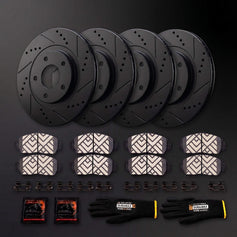
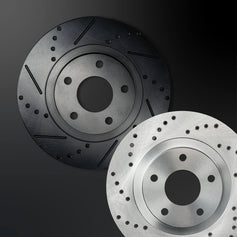
Rotors: Heavier vehicles need larger diameter rotors with greater minimum thickness to absorb and dissipate more heat. SUV and truck rotors typically require 15 to 20 mm of thickness, compared to 12 to 15 mm for sedans. The additional mass and surface area give the rotor more capacity to handle repeated hard stops without warping.
Pad friction material: Truck and SUV pads use compounds rated for higher sustained temperatures. Standard sedan compounds can glaze or fade under the thermal demands of a heavier vehicle, particularly during towing or mountain descents.
Caliper design: Heavy-duty trucks often use multi-piston calipers that distribute clamping force more evenly across larger rotor surfaces. This improves both stopping consistency and pad life.
Hydraulic system capacity: HD trucks like the F-350 are equipped with larger-bore master cylinders and, where applicable, trailer brake controllers to manage the additional load that comes with towing.
These differences add up at the shop, too. Rotor replacement is the primary driver of higher brake service costs for trucks: $500 to $800+ CAD per axle, compared to $300 to $500 CAD for sedans.
The Fitment Problem: Two Identical Trucks Can Have Different Brakes
This is where many truck and SUV owners run into trouble. Two vehicles of the same year, make, and model can have completely different brake specifications depending on trim level and factory brake packages. A base-model half-ton and the same truck with a tow package may use different rotor diameters and caliper configurations entirely.
Wheel size upgrades, off-road packages, and performance trims frequently include larger brake components. Generic or "universal fit" parts won't match these specifications, and installing the wrong rotor size leads to poor braking performance, uneven wear, and potentially dangerous conditions.
This is exactly why we built our vehicle-specific search tool. Every part is matched by exact vehicle, trim, and package. Our OEM-spec parts match the original rotor weight and vane count, backed by a 100% fitment guarantee. No guessing, no returns because the part doesn't fit.
It's also worth noting that pads, rotors, and calipers work as a system. Replacing components in isolation (such as new pads on worn rotors) creates mismatched wear patterns and inconsistent braking performance across the axle.
Canadian Conditions Make It Worse: Salt, Winter, and Corrosion
Road salt and freeze-thaw cycles accelerate rotor surface corrosion, and the effect is amplified on SUVs and trucks where rotors are larger and more exposed. After winter storage or even a few weeks of extended parking, corroded rotors cause uneven pad contact, steering wheel vibration, and reduced stopping power.
Coated or treated rotors are a meaningful upgrade for Canadian SUV and truck owners. They're not just a premium upsell; they directly address the conditions your vehicle faces for five or more months of the year.
A Canadian survey of randomly stopped heavy trucks found that over 10% of vehicles using self-adjusting brakes had at least one brake out of adjustment. That statistic underscores a simple point: regular inspection matters, especially in harsh climates where corrosion and thermal cycling take a constant toll on brake components.
Your Replacement Strategy: What to Do Differently
- Inspect more frequently. If you tow, haul payload, or drive in stop-and-go traffic regularly, don't rely on standard passenger car inspection intervals. Check pads and rotors at least twice a year.
- Choose pad compounds rated for your actual use. Standard commuting, towing, and off-road driving each place different thermal demands on your pads. A compound that works fine for grocery runs may fade under a loaded trailer.
- Select rotors by exact vehicle spec. Confirm rotor diameter, thickness, and vane count match your OEM requirements. Our vehicle-specific search tool handles this automatically.
- Treat brake upgrades as part of your towing setup. OEM brakes are tuned for unloaded driving. If you tow regularly, upgraded pads and rotors should be part of the plan, not an afterthought.
- Replace pads and rotors together per axle. This ensures even wear and consistent performance across the entire braking system.
With warehouses in both Canada and the United States, Max Advanced Brakes ships free on all orders with no tariff or duty fees for Canadian buyers. Our 90-day extended return policy gives you time to confirm everything fits and performs as expected.
The Right Brakes for a Heavier Vehicle Start with the Right Fit
Heavier vehicles generate more heat, wear components faster, and demand parts engineered for their specific weight and use case. Applying sedan logic to an SUV or truck isn't just inefficient; it's a safety risk.
Fitment precision is non-negotiable. The same model truck in different trims can require completely different brake specifications, down to rotor diameter, vane count, and caliper configuration.
Canadian SUV and truck owners who match their brake strategy to their vehicle's actual weight, use, and driving conditions will stop safer and replace parts less often. That's physics, not marketing.