

By: Max Advanced Brakes
The Price Tag Isn't the Whole Story
At first glance, a brake kit looks like the pricier option. But the sticker price alone doesn't tell you what you'll actually spend. The real comparison has to include hardware, shipping, and the risk of paying for labor twice.
The answer depends on one key variable: rotor condition. This article walks through two scenarios (rotors still in spec versus rotors that are marginal or scored) so you can make the right call for your vehicle and your wallet.
What You Actually Pay When Buying Separately
Breaking down the real cost of sourcing brake pads and rotors individually: pads typically run $30 to $50 per wheel, while rotors cost $40 to $70 per wheel. That's $140 to $240 per axle for just those two components.
Individual purchases frequently leave out critical installation hardware: clips, shims, and caliper lube. Those extras add another $15 to $30 per axle, and they're easy to overlook until you're mid-install.
Separate orders also mean separate shipping charges. Two or three shipments from different retailers can add $20 to $40 in delivery fees, eroding any perceived savings quickly.
There's a performance cost too. Pads and rotors from different manufacturers aren't always engineered to work together. Mismatched components can cause brake noise, uneven wear, and reduced stopping power. Keep in mind that brake pads must always be replaced in axle pairs — mixing lining thicknesses causes pulling and uneven braking, which is a safety issue, not just an inconvenience.
What a Brake Kit Actually Costs — and Includes
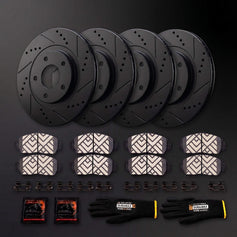
A complete brake kit (pads plus rotors bundled together) typically runs $120 to $400 CAD for mainstream passenger vehicles. Once you factor in the hardware included in most kits at no extra charge, that price is often comparable to, or less than, sourcing everything separately.
Reputable kit manufacturers report savings of 15% to 45% over buying components individually when hardware and shipping are accounted for. Those numbers hold up when you run the math yourself.
Beyond price, kits deliver something harder to quantify: matched, engineered-to-work-together components. There's no compatibility guesswork. The pads and rotors are designed for each other, which means better initial bite, quieter operation, and more predictable wear patterns.
Warranty coverage is another advantage. Kits from reputable suppliers carry a unified warranty. When you mix brands across separate purchases, coverage can be split or voided entirely if one manufacturer blames the other's product.
At Max Advanced Brakes, we offer four tiered brake kit lines to match different driving styles and budgets. Our vehicle-specific search tool lets you find the exact fit for your car or truck in seconds, so you can compare options without guesswork. Every kit ships with a 100% fitment guarantee.
The Scenario That Changes Everything: Your Rotor Condition
If your rotors are still within spec (no scoring, within thickness tolerance), buying pads only is a perfectly legitimate and cost-effective choice. There's no reason to replace parts that still have life in them.
But if your rotors are marginal or scored, replacing pads alone leads to premature pad wear, vibration, and a return shop visit. You'll end up replacing the pads again when the rotors finally give out. That's the double-labor trap.
Here's what that trap costs: shop labor rates in 2026 routinely sit between $150 and $220 per hour. Two separate brake visits can cost $300 to $440 in labor alone, compared to one combined job. That's money thrown away on a problem you could have solved the first time.
Front brakes handle 60% to 70% of all stopping work due to weight transfer during braking. That means front rotors and pads are far more likely to need simultaneous replacement than rears.
For Canadian drivers, this calculation tilts even further toward kits. Road salt and harsh winter conditions accelerate rotor corrosion and scoring at a rate that drivers in milder climates simply don't experience. If you're driving through Canadian winters, your rotors are taking a beating every season. The kit is the smarter call more often than not.
DIY vs. Shop: How Your Install Plan Affects the Math
Professional brake pad and rotor replacement costs $300 to $600 CAD per axle at most shops in 2026, or $600 to $1,200 CAD for all four wheels. Dealerships typically charge 20% to 40% more than independent shops for the same work.
DIY parts-only cost runs $150 to $300 CAD per axle, a significant saving. First-time DIYers should factor in $200 to $400 CAD in startup tool costs for jack stands, a torque wrench, and caliper tools. Those tools pay for themselves after the first job.
If you're going to a shop, replacing pads and rotors together in one visit often yields a 10% to 15% labor discount versus staggered repairs. One visit, one bill, less total cost.
One important note on quality: budget brake kits priced under $40 show 42% more premature pedal drop complaints according to ASE survey data. The mid-range kit is the value sweet spot for everyday drivers. You don't need a $3,000 big brake kit, but the cheapest option on the shelf will cost you more in the long run.
Kit or Separate? A Simple Decision Framework
The decision is straightforward. If your rotors are in good shape, pads-only is fine. If your rotors are marginal or scored, a kit saves you money overall.
Kits win on convenience, compatibility, hardware inclusion, and warranty simplicity. Use our vehicle-specific search tool to find the right brake kit for your exact vehicle before deciding. Knowing your options makes the choice easy.